Coming Full Circle: More Inspiration
More Pictures from https://www.venture4th.it/post/full-circle-from-the-uk-to-italy-via-switzerland-australia-and-spain

This quiet corner of the kitchen captures Francesca’s life in Italy with remarkable clarity. There is a simplicity here that feels intentional rather than minimal — a space shaped by use, not decoration. The Carrara marble countertop, although part of the kitchen renovation, could easily have been an original element preserved like many of the existing features of the home.
The details tell the story. A row of well-used knives speaks to a life lived through cooking. A bowl of fresh fruit, likely purchased that morning, reflects a rhythm guided by season and locality. A small arrangement of objects — a piece of art, two simple bowls — adds just enough warmth without disturbing the calm.
The kitchen is where Francesca feels most at home. She cooks daily, working with fresh ingredients sourced nearby, embracing a way of living that is both grounded and deeply Italian. Even the cookbook rests on what appears to be a traditional dough tool — a quiet, practical gesture that reflects her approach: to use what is at hand, without excess.
The book itself feels like a reflection of her journey. Its author, born in Australia to Italian parents, remained closely tied to his heritage. Francesca’s path mirrors this in a different way — born in Britain, she has returned to her grandmother’s town, rediscovering her roots not as memory, but as a way of life.
In this small, uncluttered space, everything is exactly as it needs to be.

Just beyond the corner of the kitchen, the Carrara marble continues to the sink and a window that opens onto the neighbouring house. Close enough to study the details, the view reveals a weathered façade softened by time — its pale pink surface muted by years of rain and damp, as so many homes are in this part of Italy.
Francesca has kept the original shutters, opened wide to the fresh air of early spring. The light is soft, diffused, and steady — the kind that quietly fills a room rather than announcing itself.
On the counter, a small arrangement gathers without intention. A pair of hand-painted ceramic candlesticks, distinctly Italian, sits beside a simple bar of soap, natural and unadorned. A white jug holds what appear to be cuttings from a recent walk — grape leaves and wild branches, loosely arranged, as if placed there without a second thought.
Nothing feels composed, yet everything belongs.
It is a small vignette, but one that captures the essence of Francesca’s life here — attentive, unforced, and deeply connected to her surroundings.
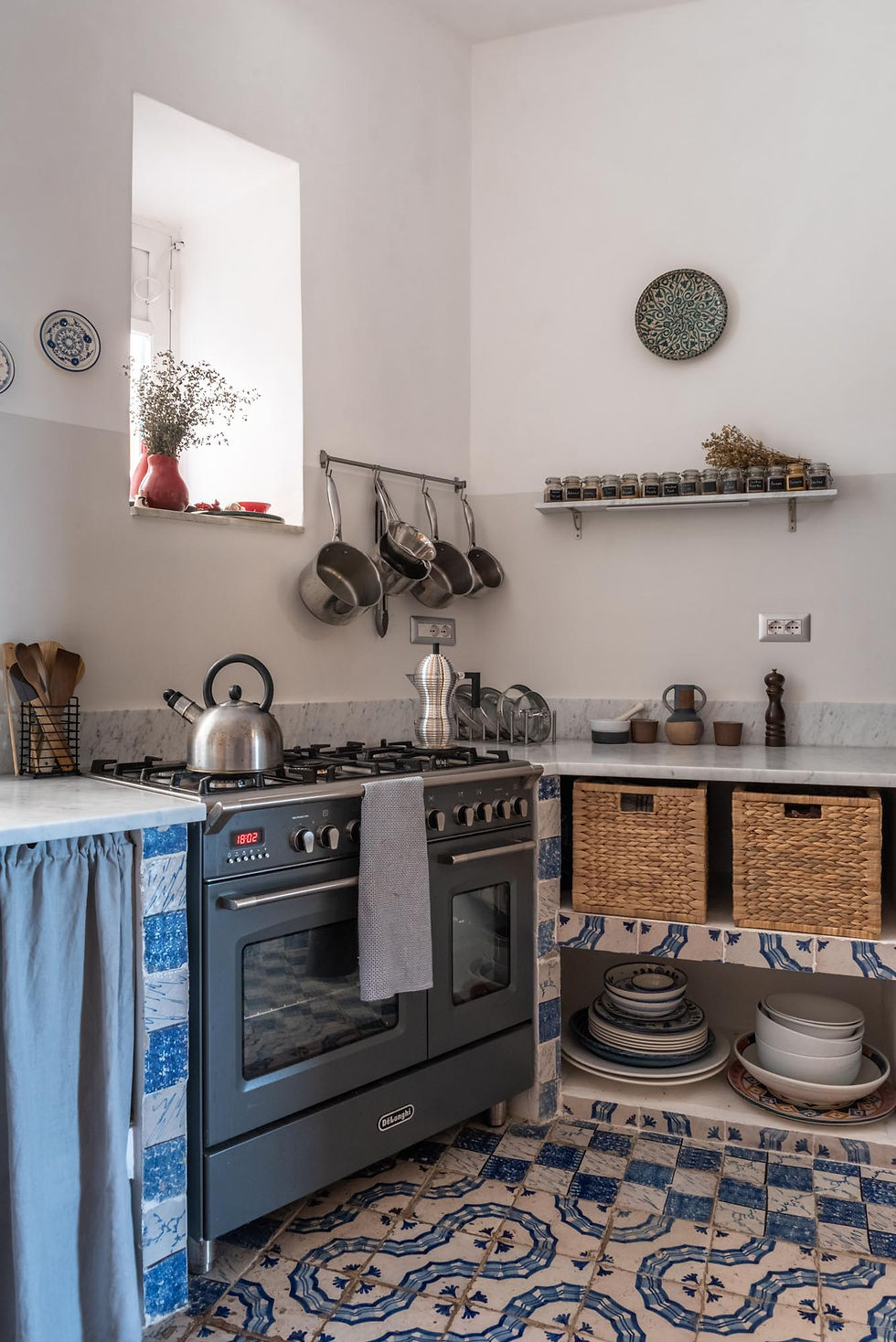
Everything about this kitchen feels quietly intentional. Light filters in from a second window set high into the wall — too elevated to offer a view, yet perfectly placed to draw in the sun and soften the room.
This is unmistakably a working kitchen. Nothing is excessive, nothing ornamental without purpose. Everything is within reach — the pots and their lids, the spices aligned in matching jars, a small bundle of dried herbs resting nearby. Wooden utensils stand ready beside the cooker, used often, returned without a thought.
The space is spare, but not empty. A small vase of dried flowers and a few simple plates hung on the wall suggest a life lived elsewhere — perhaps gathered along the way, possibly from Spain, the last place Francesca called home before moving to Italy.
The original blue tiles remain, anchoring the room with their pattern and age. A simple curtain conceals the storage beneath the sink, a practical solution that adds to the charm rather than detracts from it.
At the centre, the stove — with its double ovens — speaks to the rhythm of daily cooking. This is a kitchen designed not for display, but for use.
Everything here is considered, yet nothing feels arranged.

Just beyond the kitchen, across the entrance hall, the space opens into a combined lounge and dining room — a natural extension of the same quiet, thoughtful approach seen throughout the house.
The eye is immediately drawn to the floor. As in the kitchen, the tiles are original, hand-painted, and deeply characterful, though here they shift in tone — from blue to warm tans and browns. It was these tiles, more than anything else, that first drew Francesca and her daughter to the house. They anchor the room, pulling the gaze downward even as it is equally tempted upward toward the dark, wood-beamed ceiling.
The dialogue between surfaces continues throughout. The door surrounds have been faux painted to resemble wood, echoing the richness above, while along the lower walls a hand-painted marble trompe l’oeil has been carefully preserved, even as the upper walls have been freshly painted.
Furnishings remain simple and considered. A comfortable sofa faces the marble fireplace, creating a place for rest and conversation. The dining table sits quietly to one side, accompanied by chairs gathered over time. Above, a brass chandelier hangs — understated, unmistakably Italian, and in keeping with the room’s restrained elegance.
Two small paintings, purchased in Australia, introduce a more personal note — a reminder of another life, carried gently into this one.
As in the kitchen, nothing here feels imposed. The room is shaped by what was already present, and by what has been thoughtfully chosen to remain.


Comments